
Body Measurements Chart
Use our Body Measurements Chart to understand exactly where and how to measure your shoulders, bust or chest, waist, hips and inseam. This visual body measurement guide provides clear reference points for both women and men and helps you record more consistent body measurements.
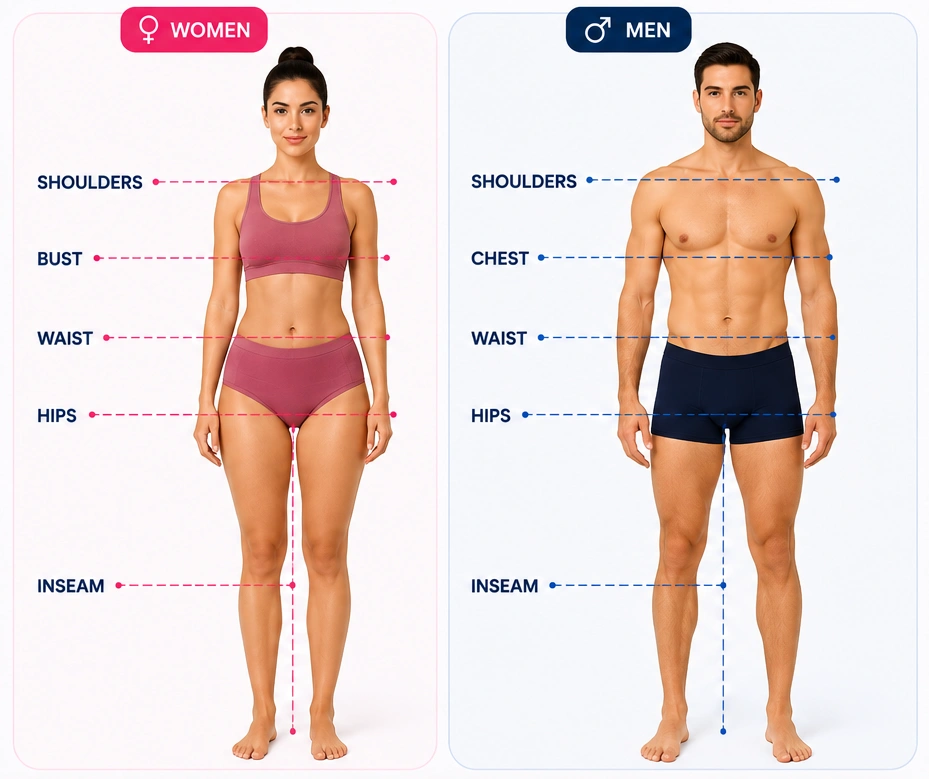
Body Measurements Chart for Women and Men
A Body Measurements Chart helps you identify the correct locations for measuring important areas of the body, including the shoulders, bust or chest, waist, hips and inseam. Taking these measurements consistently is useful when comparing body proportions, checking a body shape, recording changes or referring to clothing size information.
This body measurement chart covers both female body measurements and male body measurements. Rather than assuming that there is one “ideal” set of measurements, it focuses on where each measurement is taken and how different measurements relate to one another.
For body-shape analysis, measurements such as the shoulders, bust, waist and hips are especially useful. You can enter these values into our Body Shape Calculator to compare your proportions automatically.
Complete Body Measurement Chart
Use this Body Measurements Chart as a quick reference for the main measurement points used in body-shape and clothing measurements.
| Measurement | Where to Measure | Keep Tape | Common Use |
|---|---|---|---|
| Shoulders | Around or across the broadest shoulder area, depending on the method | Consistent with chosen method | Body proportions and body shape |
| Bust | Around the fullest part of the bust | Level and comfortably snug | Female body measurements and clothing |
| Chest | Around the fullest part of the chest | Approximately horizontal | Male measurements and clothing |
| Natural Waist | Around the natural waistline | Snug without compressing | Body proportions and clothing |
| Hips | Around the fullest part of hips and buttocks | Approximately level | Body shape and clothing |
| Inseam | From the crotch area down the inside leg | Straight along inside leg | Trouser and pants length |
| Arm Length | From shoulder area toward wrist | Follow chosen sizing method | Sleeve length |
| Thigh | Around the fullest part of the upper thigh | Level and not overly tight | Garment and body tracking |
Important: Different clothing brands, research protocols and measurement systems may define specific landmarks differently. Always follow the method required for your particular purpose and use the same method when comparing measurements over time.
Body Measurements Chart for Women
A body measurements chart female guide commonly focuses on bust, waist and hip measurements, but shoulder width and other dimensions can also be useful when evaluating overall body proportions.
Bust Measurement
Measure around the fullest part of the bust. Keep the tape comfortably snug and avoid deliberately pulling it tight.
Waist Measurement
Measure around the natural waist. Keep your posture relaxed and avoid holding your breath or pulling in your stomach.
Hip Measurement
Measure around the fullest part of the hips and buttocks while keeping the measuring tape approximately level.
Shoulder Measurement
Shoulder measurements can help distinguish female body types where upper-to-lower body balance is important.
Inseam Measurement
Measure along the inside of the leg from the crotch region toward the desired trouser or ankle point.
Arm & Sleeve
Arm or sleeve measurements can be useful for garment sizing but are generally not required to determine a female body shape.
For a dedicated guide to the three measurements most frequently used for female proportions, see How to Measure Bust, Waist and Hips .
Bust Waist Hip Measurements Explained
Bust waist hip measurements, sometimes abbreviated as BWH measurements, provide a simple way to compare three major body circumferences. They are particularly useful when exploring female body proportions.
For example, measurements written as 36-28-38 generally refer to a 36-inch bust, 28-inch waist and 38-inch hips when inches are the specified unit. The numbers alone, however, should not automatically be treated as a particular body type.
The proportional differences between the measurements matter. Shoulder measurements can also be important, particularly when distinguishing between shapes such as rectangle and inverted triangle.
Want to compare your numbers? Enter them into our Bust Waist Hip Measurements Calculator to examine your BWH measurements more easily.
Body Measurements Chart for Men
A male Body Measurements Chart often emphasizes chest, waist, shoulders, hips and inseam. The exact measurements required depend on whether the purpose is clothing, body-proportion comparison or another measurement task.
| Male Measurement | General Measurement Area | Typical Purpose |
|---|---|---|
| Chest | Around the fullest chest area | Shirts, jackets and upper-body reference |
| Waist | Around the required waist landmark | Body measurements and clothing |
| Hips | Around the fullest hip/buttock area | Trousers and proportional comparison |
| Shoulders | Across or around shoulder region according to method | Upper-body proportions and clothing |
| Inseam | Inside leg length | Trouser length |
Male and female measurements should not be interpreted as fixed standards for how a body “should” look. A Body Measurements Chart is primarily a reference for measurement locations and proportional comparison.
How to Take Body Measurements Correctly
Consistency is essential when using a body measurement chart. Follow these basic steps before recording your measurements.
Use a Flexible Tape
Use a flexible measuring tape that can follow the body’s contours without stretching.
Stand Naturally
Maintain a relaxed, natural posture instead of deliberately changing your stance or pulling in your abdomen.
Locate the Correct Area
Identify the appropriate measurement landmark before placing the tape around the body.
Keep the Tape Consistent
For circumference measurements, avoid twisting the tape and keep it approximately level where the measurement protocol requires it.
Do Not Compress the Body
The tape should generally sit comfortably against the body without being pulled excessively tight.
Record the Measurement
Write down each result immediately and record whether you are using inches or centimeters.
Repeat if Necessary
If a measurement seems inconsistent, repeat it using the same measurement point and technique.
Use One Unit
When comparing measurements, keep all values in inches or all values in centimeters.
How to Measure Your Bust
The bust is one of the most important female body measurements used in clothing and body-proportion comparisons. Wrap the measuring tape around the fullest part of the bust and keep it approximately level around the torso.
The tape should sit comfortably against the body rather than compressing it. Record the measurement using the same unit you plan to use for the waist and hips.
How to Measure Your Chest
Chest circumference is commonly included in a Body Measurements Chart for men. It is generally taken around the fullest part of the chest while maintaining a natural posture.
For garment sizing, follow the measurement instructions provided by the specific clothing manufacturer because measurement landmarks and size conversions can differ between brands.
How to Measure Your Waist
Waist measurement is used in body-proportion comparisons as well as many clothing measurements. For body measurement purposes, locate the waist landmark specified by the measurement method you are following and wrap the tape around the torso without excessive compression.
Avoid changing your normal posture simply to produce a smaller measurement. Consistency is more useful than trying to achieve a particular number.
External reference: The World Health Organization report on waist circumference and waist-to-hip ratio includes standardized guidance concerning waist and hip circumference measurement.
How to Measure Your Hips
For a general hip circumference measurement, the tape is placed around the fullest area of the hips and buttocks according to the chosen measurement protocol. Keep the tape approximately horizontal and avoid pulling it excessively tight.
Hip measurements are especially important when comparing female body measurements because hip-to-bust, hip-to-waist and hip-to-shoulder relationships can help distinguish different body shapes.
How to Measure Your Shoulders
Shoulder measurement requires particular care because different body-shape methods may use shoulder width or shoulder circumference. Use the same method consistently when comparing your results.
Shoulder proportions are useful for distinguishing an Inverted Triangle Body Shape from shapes where the shoulders and hips are more balanced.
For example, the Rectangle Body Shape usually shows greater balance between the upper and lower body than an inverted triangle figure.
How to Measure Your Inseam
Inseam is primarily a clothing measurement rather than a measurement used to calculate body shape. It represents the inside-leg length from the crotch region toward the ankle or desired trouser length.
When buying clothing, always compare your inseam with the sizing instructions of the manufacturer rather than assuming that one universal size chart applies to every brand.
Body Measurements Chart in Inches and CM
You can record body measurements in either inches or centimeters. For proportional calculations, the important requirement is that all values use the same unit.
Conversion:
1 inch = 2.54 centimeters
1 centimeter ≈ 0.3937 inches
For example, a 30-inch measurement converts to 76.2 centimeters. Changing the measurement unit does not change your underlying body proportions.
External reference: The National Institute of Standards and Technology (NIST) guidance on SI units of length provides authoritative information about length units and conversions.
How Body Measurements Help Determine Body Shape
A Body Measurements Chart becomes especially useful when you want to compare body proportions. Female body shapes are often described by relationships among the shoulders, bust, waist and hips rather than by any one measurement.
For example, balanced bust and hips combined with stronger waist definition may resemble an Hourglass Body Type. Hips that are proportionally wider than the upper body may resemble a Pear Body Shape.
A straighter relationship between the bust, waist and hips may be closer to a Rectangle Body Shape, while greater upper-body width compared with the hips can indicate an Inverted Triangle Body Shape.
Central or upper-torso emphasis may be more consistent with an Apple Body Shape. These labels describe general proportional patterns rather than health or attractiveness.
Female Body Measurements and Body Shape Patterns
| Body Shape | Upper vs Lower Body | Waist Pattern | Common Visual Relationship |
|---|---|---|---|
| Hourglass | Generally balanced | More defined | Bust and hips balanced with narrower waist |
| Pear | Lower body wider | Can be defined | Hips more prominent than upper body |
| Rectangle | Generally balanced | Less contrast | Straighter overall proportions |
| Inverted Triangle | Upper body wider | Variable | Shoulders wider relative to hips |
| Apple | Central/upper emphasis | Usually less defined | More visual fullness around torso |
See our complete Female Body Types Guide and Body Type Chart for Women for a more detailed comparison.
Body Measurements vs Clothing Size
Body measurements and clothing sizes are not the same thing. Your actual measurements describe dimensions of your body, while clothing sizes are labels assigned to garments by manufacturers.
There is no single universal clothing size system that maps every bust, chest, waist or hip measurement to the same size across every brand. A person may therefore wear different labeled sizes from different manufacturers despite having unchanged body measurements.
Use your actual measurements together with the size chart supplied by the specific clothing brand when selecting garments.
Is There an Ideal Body Measurements Chart?
There is no single set of body measurements that every woman or man should have. Human bodies naturally vary in height, skeletal proportions, body composition and overall dimensions.
A Body Measurements Chart should therefore be used as a measurement and reference guide, not as a standard for judging whether a person’s body is “ideal.”
Similarly, body-shape categories describe proportional patterns. They do not rank one body shape above another.
Why Accurate Body Measurements Matter
A small change in tape placement can produce a different measurement. This is particularly important when measurements are being compared over time or used in a calculation.
For more reliable comparisons, use the same measurement landmarks, the same units and the same general technique each time.
External reference: The U.S. Centers for Disease Control and Prevention (CDC) NHANES Anthropometric Procedures Manual provides detailed examples of standardized anthropometric measurement procedures used in health examination surveys.
Common Body Measurement Mistakes
Pulling Tape Too Tight
Excessive tension can compress soft tissue and change the recorded circumference.
Using the Wrong Landmark
Measuring the waist or hips at different locations can produce inconsistent results.
Mixing Inches and CM
Do not enter some measurements in inches and others in centimeters when comparing proportions.
Changing Posture
Standing unnaturally or holding in the stomach can make measurements less consistent.
Guessing Measurements
Use an actual flexible measuring tape rather than estimating your bust, waist or hip circumference.
Assuming One Size Chart
Garment sizing varies, so use the manufacturer’s own chart when selecting clothing.
Body Measurement and Body Shape Resources
Body Measurements Chart FAQs
What is a Body Measurements Chart?
A Body Measurements Chart is a reference showing where key body measurements such as shoulders, bust or chest, waist, hips and inseam are generally taken.
What are the main female body measurements?
Common female body measurements include bust, waist and hips. Shoulders can also be useful when comparing female body types, while inseam and other dimensions are commonly used for clothing.
What are bust waist hip measurements?
Bust waist hip measurements are three body circumferences commonly written as B-W-H. They can help describe body proportions and are also used in some clothing and body-shape comparisons.
Should I measure my body in inches or centimeters?
Either unit can be used. The important requirement is to use the same unit consistently for all measurements being compared.
How do I measure my waist correctly?
Use the waist landmark specified by your measurement method, keep the tape comfortably snug and avoid deliberately changing your posture or pulling in your abdomen.
Where should I measure my hips?
For a general hip circumference, measure around the fullest area of the hips and buttocks according to the measurement protocol you are using.
Can body measurements determine my body shape?
Measurements can help compare body proportions. Shoulder, bust, waist and hip relationships are commonly used to estimate body-shape categories such as hourglass, pear, rectangle, apple and inverted triangle.
Are body measurements the same as clothing sizes?
No. Body measurements describe physical dimensions, while clothing sizes are manufacturer-specific labels and can vary between brands.
Is there an ideal female Body Measurements Chart?
No. There is no single ideal set of female measurements. A Body Measurements Chart should be used as a measurement reference rather than a standard for judging a person’s body.
How often should I repeat body measurements?
The appropriate frequency depends on why you are measuring. When comparing measurements over time, consistency in technique and measurement landmarks is more important than measuring frequently.
Use Your Body Measurements to Find Your Body Shape
Now that you know how to use a Body Measurements Chart, enter your shoulder, bust, waist and hip measurements into our free calculator to compare your proportions and identify your closest body-shape pattern.
🧮 Calculate My Body Shape →