
Female Body Types: 5 Common Body Shapes
Learn the five common Female Body Types and how body proportions differ between hourglass, pear, apple, rectangle and inverted triangle shapes. Compare shoulders, bust, waist and hips to better understand the body-shape pattern that most closely matches your measurements.
What Are the 5 Common Female Body Types?
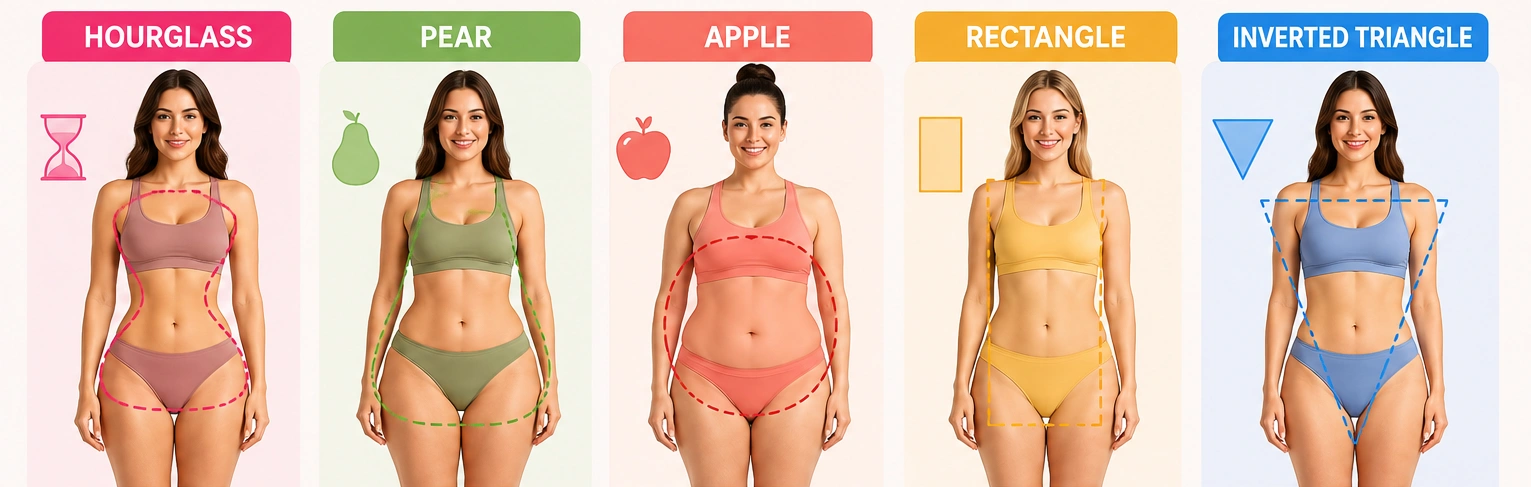
Female Body Types are commonly described by comparing the proportions of the shoulders, bust, waist and hips. Five widely used female body shapes are hourglass, pear, apple, rectangle and inverted triangle. These categories provide a simple way to describe how the upper body, waist and lower body relate to one another.
Understanding female body types is not about deciding whether one shape is better than another. Women naturally have many different body proportions, and two women with very different heights, weights or clothing sizes can still have a similar body shape.
If you are trying to answer “what is my body type?”, start with accurate body measurements. Comparing your shoulders, bust, waist and hips is generally more useful than judging your figure from weight or dress size alone.
Female Body Types and Shapes Explained
The following five body shapes for women describe common proportional patterns rather than strict rules.
Hourglass Body Type
The bust and hips are relatively balanced while the waist is noticeably smaller, creating stronger waist definition.
Pear Body Shape
The hips are proportionally wider than the bust or shoulders, producing a lower-body dominant silhouette.
Apple Body Shape
The middle torso tends to show greater fullness and the waist may have less contrast with the upper and lower body.
Rectangle Body Type
Shoulders, bust and hips appear relatively balanced with less difference between the waist and surrounding measurements.
Inverted Triangle
The shoulders or upper body are proportionally broader than the hips, creating an upper-body dominant shape.
Female Body Types Chart: Compare All 5 Shapes
Use this female body types chart to compare the main proportional characteristics of common women’s body types.
| Female Body Type | Shoulders / Bust | Waist | Hips | Main Characteristic |
|---|---|---|---|---|
| Hourglass | Similar to hips | Clearly defined | Similar to bust | Balanced upper and lower body |
| Pear | Narrower than hips | Often defined | Wider | Lower-body dominant |
| Apple | Variable | Less defined | Variable | More fullness through middle |
| Rectangle | Relatively balanced | Less contrasted | Relatively balanced | Straighter overall proportions |
| Inverted Triangle | Broader | Variable | Narrower | Upper-body dominant |
How to Determine Your Female Body Type
To determine which of the female body types most closely describes your figure, measure your shoulders, bust, waist and hips and compare the relationships between those measurements.
Shoulders
Measure consistently around or across the shoulder area using the method required by your calculator.
Bust
Measure around the fullest part of the bust while keeping the tape approximately level.
Waist
Measure your waist without pulling the tape excessively tight against the body.
Hips
Measure around the fullest part of the hips and buttocks for your lower-body comparison.
Compare
Compare the four measurements to determine which body-shape pattern is the closest match.
For complete instructions, see our Body Measurements Guide and How to Measure Bust Waist and Hips.
1. Hourglass Female Body Type
The hourglass is one of the best-known female body types. In an hourglass pattern, the bust and hips are relatively close in proportion, while the waist is noticeably smaller.
The important characteristic is proportional balance rather than a specific measurement such as 36-24-36. A smaller or larger woman can have hourglass proportions if her upper and lower body are relatively balanced and her waist is clearly defined.
This is why bust waist hip measurements can be more useful than clothing size when comparing female body types.
2. Pear Female Body Shape
A pear body shape generally has hips that are proportionally wider than the shoulders or bust. The waist may also be clearly visible, creating a silhouette that becomes wider through the lower body.
When comparing different types of female body shapes, the main difference between pear and hourglass is the balance between the upper and lower body. Hourglass proportions are more balanced, whereas pear proportions are more dominant through the hips.
3. Apple Female Body Shape
The apple body shape generally describes proportions with more fullness through the middle torso and less waist definition. Bust, shoulders and hips can vary considerably between individuals.
For that reason, identifying an apple shape should be based on overall proportions rather than one measurement alone.
4. Rectangle Female Body Type
A rectangle body type has relatively similar upper-body and hip proportions with less difference at the waist. This produces a straighter silhouette through the torso.
Rectangle does not mean that all three BWH measurements are identical. Instead, it means the difference between the waist and the bust or hips is generally less pronounced than in an hourglass pattern.
5. Inverted Triangle Female Body Type
An inverted triangle body type has a proportionally broader upper body compared with the hips. The shoulders are especially useful when distinguishing this shape from other female body types.
This demonstrates why a body shape assessment based only on bust, waist and hips can sometimes be incomplete. Shoulder proportions provide additional information about the overall silhouette.
Are Female Body Types and Body Shapes the Same?
Female Body Shape
Body shape usually refers to visible proportional patterns such as hourglass, pear, apple, rectangle and inverted triangle.
Female Body Type
The phrase “body type” is broader, but online searches often use female body type and female body shape interchangeably when referring to these proportional categories.
If you are asking “what is my body type?”, our Female Body Type Calculator can compare your measurements automatically.
Bust Waist Hip Measurements and Female Body Types
Bust, waist and hip measurements are commonly written as three numbers in BWH order. For example, 36-28-38 represents a 36-inch bust, 28-inch waist and 38-inch hips.
These numbers become more useful for body-shape analysis when they are compared proportionally. A defined waist, similar bust and hip measurements, or a larger difference between bust and hips can all help distinguish different female body types and shapes.
You can compare these values with our Bust Waist Hip Measurements Calculator .
Does Clothing Size Determine Female Body Shape?
No. Clothing size and female body shape describe different things. Dress size is primarily intended to help select garments, whereas body shape describes proportional relationships between different areas of the body.
Two women wearing the same clothing size can have different body shapes. Likewise, two women with very different clothing sizes can share similar hourglass, pear, rectangle or inverted triangle proportions.
Can Female Body Types Change?
Body proportions can change over time. Changes in body composition, age and other factors may alter the relationship between waist, hips, bust and other measurements.
Because female body types are proportional descriptions rather than permanent biological categories, a person’s closest body-shape classification can also change if those proportions change.
Do Real Women Fit Perfectly Into the 5 Body Shapes?
Not necessarily. The five common female body types are simplified categories. Human bodies vary continuously, so many women naturally share characteristics of more than one shape.
For example, someone may have hips slightly wider than her bust but still have strong hourglass-like waist definition. Another person may fall between rectangle and inverted triangle proportions.
A body shape result should therefore be treated as the closest proportional match, not an absolute label.
Visualize Different Female Body Shapes
Measurements are useful, but seeing body proportions visually can make the differences between women’s body types easier to understand.
Our Body Shape Visualizer creates a simplified visual representation from body measurements so you can compare upper-body, waist and hip proportions more easily.
You can also view our Body Type Chart for Women for a side-by-side comparison of the five common female body shapes.
What Female Body Type Am I?
If you are unsure which female body type you have, avoid choosing a shape based only on appearance. Take your measurements first and compare your shoulders, bust, waist and hips.
Our detailed What Body Shape Am I? guide explains the process step by step, while the Body Shape Calculator can perform the proportional comparison automatically.
Why Accurate Body Measurements Matter
Body-shape calculations depend on the measurements entered. A tape that is positioned differently each time, pulled too tightly or allowed to hang loosely can change the result.
For more consistent comparisons, use the same measurement method and the same units each time you record your measurements.
Authoritative reference: The World Health Organization report on waist circumference and waist-to-hip ratio provides standardized guidance concerning waist and hip circumference measurement.
Female Body Measurements and Anthropometry
The measurement of human body dimensions is generally known as anthropometry. Circumferences and other physical measurements can be used to describe body dimensions and proportions.
Authoritative reference: For background information about anthropometric measurement, see the NCBI overview of Anthropometric Measurement .
Can I Measure Female Body Types in CM or Inches?
Yes. Body measurements can be recorded in either centimeters or inches. For proportional comparisons, the key requirement is that all measurements in the same calculation use the same unit.
One inch is exactly 2.54 centimeters, so converting all measurements consistently does not alter their proportional relationship.
Authoritative reference: See NIST guidance on SI units of length for official measurement-unit information.
Are Female Body Types a Measure of Health?
No. Female body types such as hourglass, pear, apple, rectangle and inverted triangle describe body proportions. They do not by themselves determine health, fitness, body composition or attractiveness.
The information on this page is intended for general body-shape and measurement comparison and should not be treated as a medical diagnosis.
Explore Female Body Types With Our Free Tools
Female Body Types FAQs
What are the 5 female body types?
The five commonly described female body types are hourglass, pear, apple, rectangle and inverted triangle.
How do I know my female body type?
Measure your shoulders, bust, waist and hips and compare their proportional relationships with common female body-shape patterns.
What is an hourglass body type?
An hourglass body type generally has relatively balanced bust and hip proportions with a more clearly defined waist.
What is a pear body shape?
A pear body shape generally has hips that are proportionally wider than the shoulders or bust.
What female body type has broad shoulders?
Shoulders that are proportionally broader than the hips commonly align with an inverted triangle body type.
Can I have two body types?
Yes. Female body types are simplified categories, and real body proportions can fall between two or more common shapes.
Does weight determine female body type?
No. These female body types are primarily descriptions of proportional relationships rather than total body weight.
Can my body shape change over time?
Yes. If body proportions change over time, the body-shape category that most closely describes those proportions can also change.
Which Female Body Type Are You?
Enter your measurements into our free calculator and compare your shoulders, bust, waist and hips to find the female body shape that most closely matches your proportions.
♀ Calculate My Female Body Type →