
What Body Shape Am I?
Wondering “What Body Shape Am I?” Learn how to identify your body shape using your shoulders, bust, waist and hip measurements. Compare your proportions with common female body shapes and discover whether your figure is closest to hourglass, pear, apple, rectangle or inverted triangle.
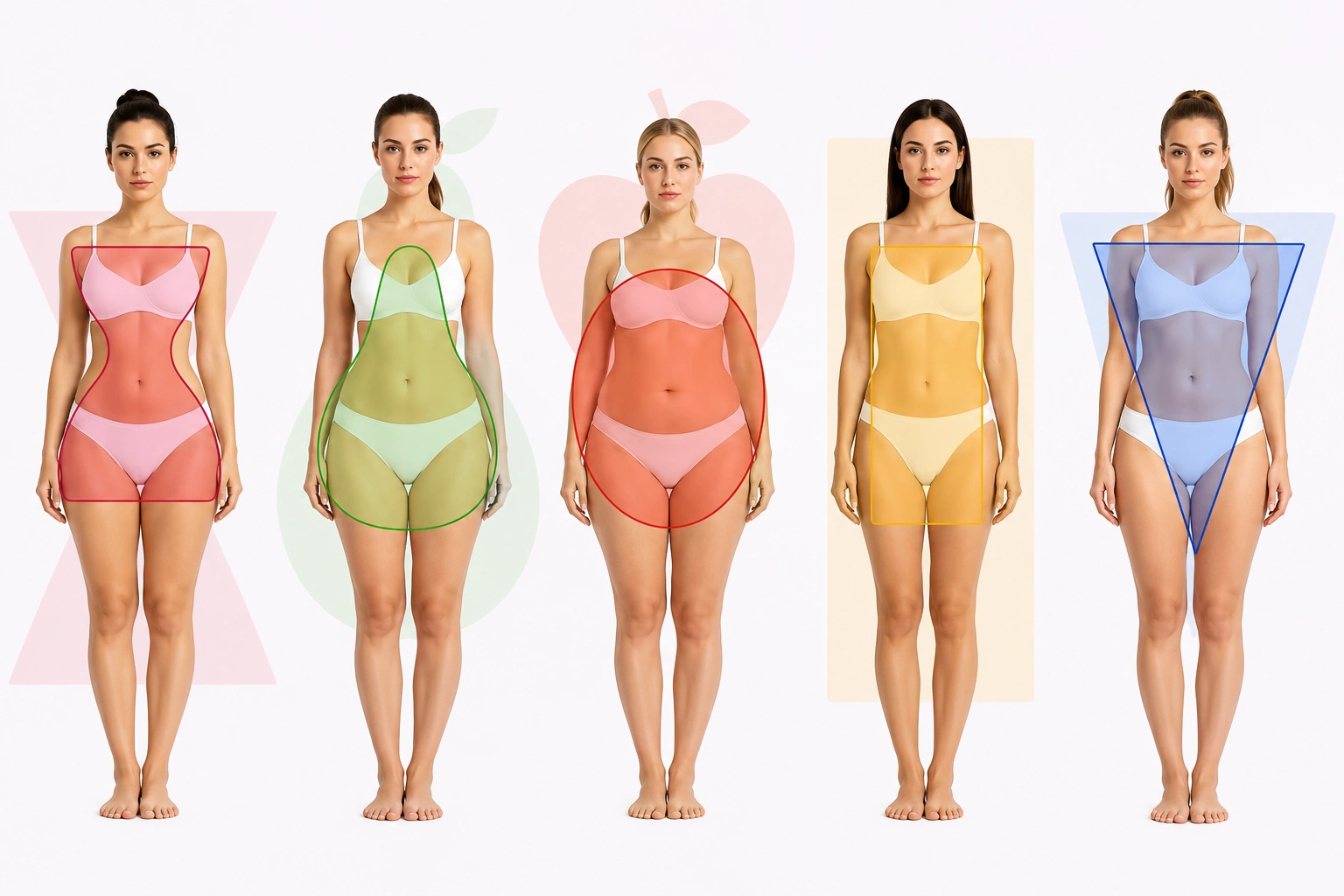
What Body Shape Am I? Start With Your Measurements
If you are asking “What Body Shape Am I?”, the best starting point is to compare your shoulders, bust, waist and hip measurements rather than relying only on how your body looks in a mirror.
Common female body shapes include hourglass, pear, apple, rectangle and inverted triangle. Each category describes a different proportional relationship between the upper body, waist and hips.
The goal is not to find a perfect label. Real bodies vary continuously, and you may have characteristics of more than one body shape.
How to Figure Out Your Body Shape in 5 Steps
Use these steps if you want to answer the question “What Body Shape Am I?” using measurements.
Measure Shoulders
Record the width or circumference method used consistently for your shoulder measurement.
Measure Bust
Measure around the fullest part of your bust while keeping the tape level.
Measure Waist
Record your waist circumference using the same measurement unit.
Measure Hips
Measure around the fullest part of your hips and buttocks.
Compare Proportions
Compare upper body, waist and hips to the common body-shape patterns below.
5 Common Female Body Shapes
The following body shape types are commonly used to describe female body proportions.
Hourglass
Bust and hips are relatively balanced with a noticeably smaller waist.
Pear
Hips are proportionally wider than the bust or shoulders.
Apple
More fullness is concentrated through the middle torso.
Rectangle
Bust, waist and hips form a straighter overall proportional pattern.
Inverted Triangle
Shoulders or bust are proportionally wider than the hips.
What Body Shape Am I? Quick Comparison Chart
| Body Shape | Shoulders / Bust | Waist | Hips | Main Pattern |
|---|---|---|---|---|
| Hourglass | Balanced with hips | More defined | Balanced with bust | Balanced upper and lower proportions |
| Pear | Relatively narrower | Often defined | Wider | Lower-body dominant |
| Apple | Variable | Less contrasted | Variable | Fuller middle torso |
| Rectangle | Similar proportion | Less defined | Similar proportion | Straighter silhouette |
| Inverted Triangle | Broader | Usually narrower | Relatively narrower | Upper-body dominant |
Measurements That Help Determine Body Shape
Shoulders
Shoulder proportions help identify whether the upper body is relatively broad or narrow.
Bust
Bust circumference helps compare the upper torso with the hips and waist.
Waist
Waist circumference shows how strongly the torso narrows through the middle.
Hips
Hip circumference provides the main lower-body comparison.
For detailed measurement instructions, visit our Body Measurements Guide or see How to Measure Bust Waist and Hips .
Why Proportions Matter More Than Size
When asking “What Body Shape Am I?”, absolute measurements are less important than how those measurements relate to each other.
Two women can have very different body sizes but still share the same overall body shape because their proportions are similar.
Compares upper and lower torso proportions.
Shows relative waist definition.
Helps identify upper or lower body dominance.
Hourglass vs Pear Body Shape
⧖ Hourglass
Hourglass proportions usually show a bust and hips that are relatively similar in size with a more defined waist.
🍐 Pear
Pear proportions usually show hips that are wider than the shoulders or bust, creating greater lower-body width.
Apple vs Rectangle Body Shape
🍎 Apple
Apple proportions generally show more fullness through the middle torso and less waist contrast.
▯ Rectangle
Rectangle proportions show a straighter torso with relatively similar bust, waist and hip widths.
What Is My Body Type vs What Is My Body Shape?
Search terms such as what is my body shape, what is my body type and what body type am I are often used interchangeably when people are trying to understand their proportions.
On this site, body shape refers primarily to the proportional relationship between shoulders, bust, waist and hips.
If you want a dedicated measurement-based result, use our Female Body Type Calculator .
Use Measurements to Find Your Body Shape
If you do not want to compare the chart manually, enter your measurements into the Body Shape Calculator .
The calculator compares shoulders, bust or chest, waist and hips and returns the body-shape category that most closely matches your proportions.
This is particularly useful if you keep asking “What Body Shape Am I?” but find the differences between categories difficult to judge visually.
Compare Female Body Types Side by Side
Another way to identify your proportions is to compare female body types side by side using our Body Type Chart for Women .
The chart focuses on five common female body shapes and shows how shoulders, bust, waist and hips differ between them.
See Your Proportions With a Body Shape Visualizer
Some people understand proportions more easily when they can see a visual representation rather than only reading measurement ratios.
Use our Body Shape Visualizer to see a simplified visual interpretation based on your measurements.
How Accurate Is Body Shape Classification?
Body shape categories are simplified descriptions of human proportions. They are useful for comparison, but real bodies do not fit perfectly into a small number of fixed categories.
Measurement technique can also affect the result. Changes in tape position, posture or measurement method may slightly alter the calculated proportions.
If your measurements fall close to the boundary between two categories, it may be more accurate to think of your figure as sharing characteristics of both shapes rather than forcing it into one label.
Body Measurements and Anthropometry
Anthropometry is the broader practice of measuring human body dimensions. Body circumference measurements are commonly included among anthropometric measurements.
External reference: For background on anthropometric measurements, body dimensions and body circumferences, see the NCBI Anthropometric Measurement overview .
Measuring Waist and Hips Consistently
Waist and hip circumference should be measured using a consistent method. This is especially important if you plan to compare measurements over time.
External reference: The World Health Organization report on waist circumference and waist-to-hip ratio discusses methods of waist and hip measurement.
Should I Measure in Inches or Centimeters?
Either inches or centimeters can be used to compare body proportions. The important rule is to use the same unit for all measurements in one comparison.
One inch is exactly 2.54 centimeters, so converting every measurement consistently does not change the proportional relationships between them.
External reference: NIST states that one inch is exactly equivalent to 25.4 millimeters. See NIST SI Units – Length .
Does Body Shape Determine Health?
No. A body-shape label such as hourglass, pear, apple, rectangle or inverted triangle is a description of proportions, not a medical diagnosis.
This guide is intended to help answer “What Body Shape Am I?” for general body-proportion understanding. It should not be used to diagnose health conditions or assess body composition.
More Tools to Find Your Body Shape
What Body Shape Am I? FAQs
What Body Shape Am I?
Compare your shoulders, bust, waist and hips. Balanced bust and hips with a defined waist may suggest hourglass, wider hips may suggest pear, a fuller middle may suggest apple, similar measurements may suggest rectangle, and broader shoulders may suggest inverted triangle.
How do I figure out my body type?
Take consistent shoulder, bust, waist and hip measurements and compare their proportions with common body-shape patterns.
What measurements determine body shape?
Shoulder, bust, waist and hip measurements are commonly compared when estimating overall body shape.
Can I be between two body shapes?
Yes. Body-shape categories are simplified descriptions, and many people naturally share features of two or more categories.
What body shape has wider hips than shoulders?
Proportionally wider hips than shoulders or bust commonly align with a pear-shaped pattern.
What body shape has broad shoulders?
Shoulders that are noticeably broader than the hips commonly align with an inverted triangle body shape.
What is the difference between hourglass and rectangle?
Both can have relatively balanced bust and hips, but an hourglass generally has more waist definition while rectangle proportions are straighter through the torso.
Is body shape based on weight?
No. Body shape in this guide is based mainly on proportional relationships between different body measurements rather than total body weight.
Still Asking “What Body Shape Am I?”
Enter your shoulder, bust, waist and hip measurements into our calculator to find the body-shape pattern that most closely matches your proportions.
🧮 Find My Body Shape →