
Body Shape Calculator
Use our free Body Shape Calculator to estimate your body shape from shoulder, bust or chest, waist and hip measurements. Compare your proportions and find the body-shape pattern that most closely matches your measurements.
Calculate Your Body Shape
Select female or male, choose your measurement unit, then enter shoulders, bust or chest, waist and hips to estimate your body-shape category.
Hourglass Body Shape
What Is a Body Shape Calculator?
A Body Shape Calculator compares measurements from different parts of the body to estimate your overall body-shape pattern. Instead of using weight or clothing size alone, it looks at shoulders, bust or chest, waist and hips.
These measurements can help answer questions such as “what body shape am I?” by showing whether your proportions are relatively balanced, broader through the upper body, wider through the hips or straighter through the torso.
The result is a practical body-proportion estimate. Real bodies vary continuously, so a person may share characteristics of more than one body shape.
How the Body Shape Calculator Works
The calculation uses proportional relationships between your upper body, waist and hips.
1. Choose Female or Male
Female mode uses bust measurements, while male mode uses chest measurements.
2. Choose Inches or CM
Keep every measurement in the same unit so the ratios remain consistent.
3. Enter Measurements
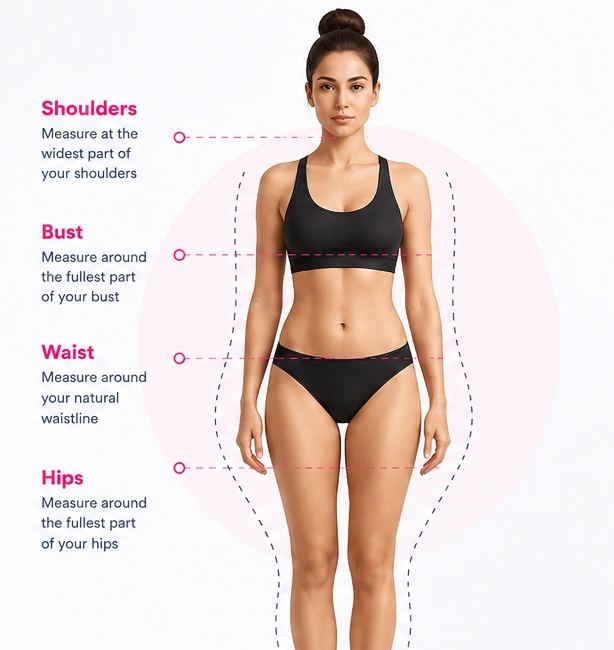
Add shoulders, bust or chest, waist and hips using a flexible measuring tape.
4. Get Your Body Shape
The tool compares your proportions and returns the closest matching body-shape category.
Common Female Body Shape Types
A female body shape calculator generally compares bust, waist and hips while also considering shoulder proportions.
Hourglass
Bust and hips are relatively balanced with a more defined waist.
Pear
Hips are proportionally wider than the bust and shoulders.
Apple
The midsection is relatively fuller compared with other measurements.
Rectangle
Bust, waist and hips form a straighter overall proportional pattern.
Inverted Triangle
Shoulders or bust are proportionally broader than the hips.
For female-specific calculations, visit our Female Body Type Calculator .
Common Male Body Shape Types
Male body shape is usually described by comparing shoulder and chest width with the waist and hips.
Inverted Triangle & Trapezoid
Inverted triangle proportions have clearly broader shoulders and a narrower lower torso. Trapezoid proportions also taper toward the waist, but the difference is generally more moderate.
Rectangle, Triangle & Oval
Rectangle shapes have relatively similar torso widths, triangle shapes are broader through the lower torso, while oval proportions generally have a fuller middle section.
For male-specific results, use the Male Body Type Calculator .
Measurements Used to Calculate Body Shape
Consistent body measurements give the calculator a stronger basis for comparing proportions.
Helps compare upper-body width with the hips.
Female mode uses bust circumference while male mode uses chest circumference.
Shows how much the middle torso narrows or remains full.
Provides the lower-body measurement used for proportional comparisons.
If you are unsure how to take these measurements, first read the Body Measurements Guide . Female users can also follow How to Measure Bust Waist and Hips .
How Body Proportions Affect the Result
A Body Shape Calculator is based primarily on relationships between measurements, not on absolute body size.
Two people can therefore have very different measurements but similar body shapes if their relative proportions are comparable.
Compares the midsection with the lower torso.
Compares upper-torso circumference with hips.
Compares upper-body width with lower-body width.
Shows how strongly the torso tapers toward the waist.
Body Shape Comparison Chart
This quick body shape chart summarizes the broad proportional differences between common figure types.
| Body Shape | Upper Body | Waist | Hips | General Pattern |
|---|---|---|---|---|
| Hourglass | Balanced with hips | More defined | Balanced with bust | Curved with narrower middle |
| Pear | Relatively narrower | Variable | Wider | Lower-body dominant |
| Apple | Variable | Fuller | Variable | More volume through middle |
| Rectangle | Similar proportion | Less defined | Similar proportion | Straighter silhouette |
| Inverted Triangle | Broader | Narrower | Relatively narrower | Upper-body dominant |
| Trapezoid | Moderately broader | Defined | Moderate | Gradual upper-body taper |
| Triangle | Narrower | Variable | Relatively wider | Lower torso broader |
| Oval | Variable | Fuller | Variable | Rounded midsection |
What Body Shape Am I?
If you are asking “what body shape am I?”, start by taking accurate measurements rather than trying to judge your figure only from a mirror.
Compare shoulders, bust or chest, waist and hips. The proportional pattern between these measurements usually provides a clearer starting point for identifying common body figure types.
The calculator above performs this comparison automatically and returns the body shape that most closely matches the measurements entered.
Body Shape Calculator vs Body Shape Visualizer
🧮 Calculator
The calculator focuses on measurements, ratios and the resulting body-shape category. It is useful when you primarily want a numerical classification.
👁 Visualizer
The Body Shape Visualizer emphasizes a simplified visual silhouette so you can see how different proportions affect the figure.
How Accurate Is a Body Shape Calculator?
Accuracy depends primarily on the measurements entered and the rules used to compare them. Incorrect tape placement or inconsistent units can change the result.
Human bodies do not fit perfectly into fixed categories. Someone can have characteristics of two different shapes, so the result should be treated as a practical estimate rather than a rigid classification.
This tool is intended for general body-proportion information and does not measure body fat, health status or body composition.
Measurement background: Anthropometric measurements are quantitative body measurements used to describe human body size and dimensions. See the NCBI Anthropometric Measurement overview .
Why Waist and Hip Measurements Matter
Waist and hip measurements help describe how the middle and lower torso relate. They are useful proportional measurements, although body-shape classification also benefits from bust, chest and shoulder measurements.
The World Health Organization report on waist circumference and waist-hip ratio discusses measurement methods for waist and hip circumferences. :contentReference[oaicite:1]{index=1}
Should I Use Inches or Centimeters?
Either inches or centimeters can be used. The important point is to use the same unit for shoulders, bust or chest, waist and hips.
One inch equals exactly 2.54 centimeters, so converting all measurements from one system to another does not change their underlying proportional relationships. NIST confirms the exact 2.54-centimeter definition of one inch. :contentReference[oaicite:2]{index=2}
For official metric and U.S. customary unit conversion information, see NIST’s measurement conversion resource .
More Body Shape & Measurement Tools
Continue with the related calculators and guides for more detailed body type and measurement analysis.
Body Shape Calculator FAQs
What is a Body Shape Calculator?
It is a measurement-based tool that compares shoulders, bust or chest, waist and hips to estimate the closest body-shape pattern.
What measurements do I need?
You need shoulder, bust or chest, waist and hip measurements entered in the same unit.
How do I know what body shape I am?
Measure your shoulders, bust or chest, waist and hips and compare the proportional relationships between them. The calculator performs this comparison automatically.
Can women use this body shape tool?
Yes. Female mode uses shoulder, bust, waist and hip measurements to estimate common female body shapes.
Can men use the calculator?
Yes. Male mode compares shoulders, chest, waist and hips to estimate common male torso proportions.
Can I use centimeters instead of inches?
Yes. Use either inches or centimeters, but keep every measurement in the same unit in one calculation.
Is body shape the same as body weight?
No. Body shape describes proportional relationships between different body areas, while body weight measures total mass.
Is the result medically accurate?
No. The result is a general body-proportion estimate and should not be used for medical diagnosis, body-fat assessment or health evaluation.
Ready to Find Your Body Shape?
Enter your shoulder, bust or chest, waist and hip measurements in the calculator above to estimate the body-shape pattern that most closely matches your proportions.
🧮 Use the Body Shape Calculator ↑