
Body Measurements Guide & Tool
Record your body measurements and compare your shoulders, chest or bust, waist and hips in one simple tool. Use the measurement summary to understand your body proportions before using a male or female body type calculator.
Record Your Body Measurements
Choose female or male, select inches or centimeters, then enter your measurements to see a simple body proportion summary.
Your Measurements
This tool organizes and compares body measurements. Ratios describe proportions only and are not a medical assessment or a standard for an ideal body shape.
What Are Body Measurements?
Body measurements are numerical measurements of different parts of the body, such as the shoulders, chest or bust, waist and hips. Together, these measurements provide a more useful picture of body size and proportions than any single measurement.
When used for body-shape analysis, body measurements and body type are closely connected. Comparing the upper body, waist and hips can help identify whether your overall proportions are relatively balanced, upper-body dominant, lower-body dominant or straighter through the torso.
This page combines a body measurements chart, measurement instructions and a free tool for organizing your measurements. It is intended for general body-proportion guidance rather than medical diagnosis or defining an “ideal” body.
Which Body Measurements Do You Need?
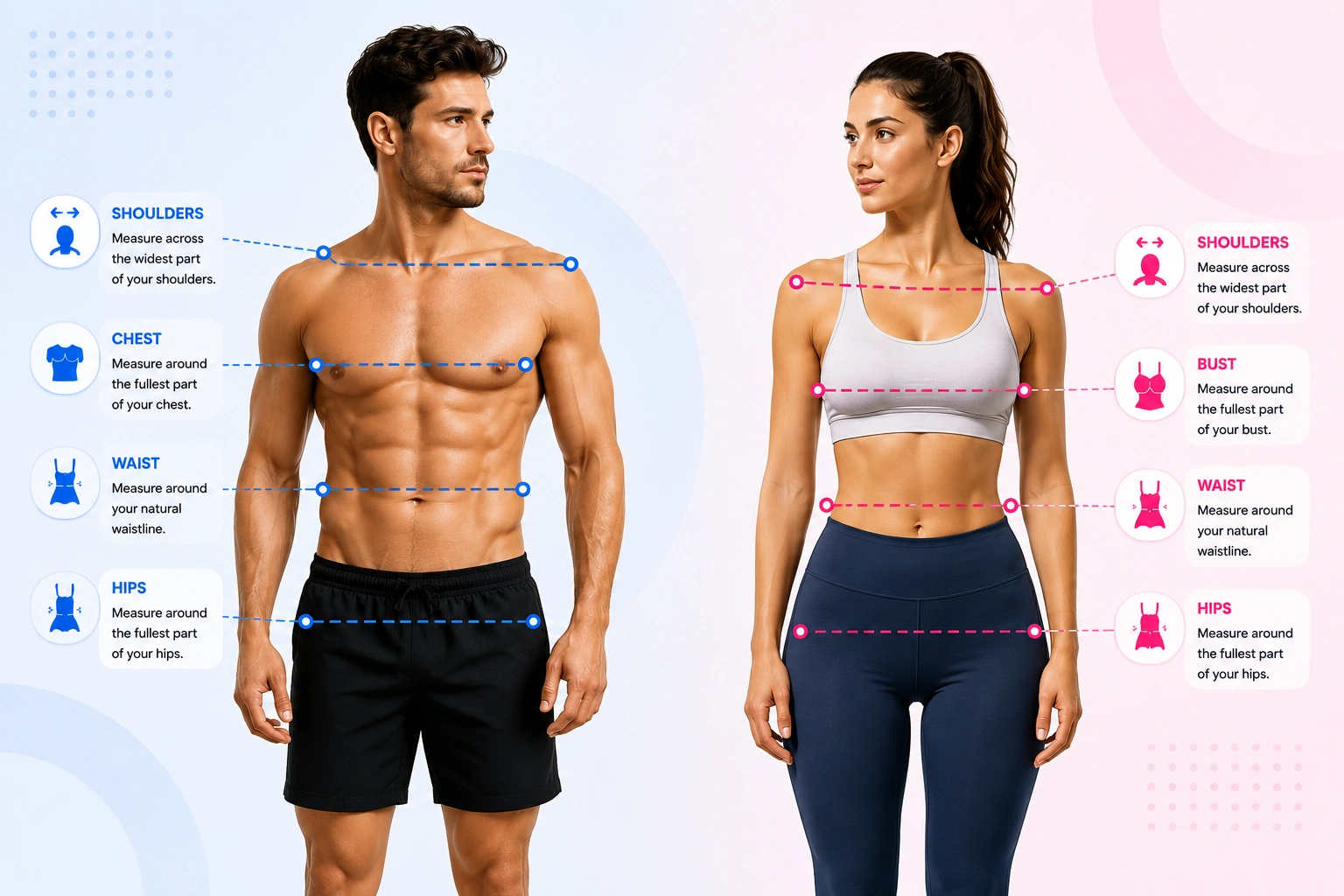
For body type and body shape measurements, the four most useful areas on this site are shoulders, chest or bust, waist and hips.
Shoulders
Measure the widest shoulder area consistently. Shoulder size helps compare upper-body width with the hips.
Chest or Bust
Men generally record chest circumference, while women commonly use bust circumference for body-shape calculations.
Waist
Waist measurement helps show how much the middle torso narrows relative to the upper body and hips.
Hips
Measure around the fullest hip and buttock area to compare lower-body proportions with the waist and shoulders.
Body Measurements Chart for Men & Women
This body measurement chart shows what each measurement represents and how it is used when comparing body proportions.
| Measurement | Women | Men | Where to Measure | Why It Matters |
|---|---|---|---|---|
| Shoulders | Used for upper-body comparison | Used for upper-body comparison | Widest shoulder area | Compares upper-body width with hips |
| Bust / Chest | Bust circumference | Chest circumference | Around the fullest part | Helps describe upper-torso proportions |
| Waist | Natural waist area | Natural waist area | Around the waist with tape level | Shows waist definition relative to upper body and hips |
| Hips | Fullest hip/buttock area | Fullest hip/buttock area | Around the fullest lower-body point | Provides the primary lower-body comparison |
Female Body Measurements vs Male Body Measurements
The basic measuring technique is similar, but the upper-torso measurement used by our calculators differs between women and men.
Female Body Measurements
For female body measurements, our body type tool compares shoulders, bust, waist and hips. Bust-waist-hip measurements, often shortened to BWH measurements, help show how the upper torso, waist and lower body relate.
These measurements can then be used to estimate common female body-shape patterns such as hourglass, pear, apple, rectangle and inverted triangle.
Male Body Measurements
For male body measurements, our tool compares shoulders, chest, waist and hips. Chest replaces bust as the main upper-torso circumference measurement.
These proportions can help estimate male body shapes such as inverted triangle, trapezoid, rectangle, triangle and oval.
How to Take Body Measurements Correctly
Consistency matters when measuring the body. Stand naturally, use a flexible tape and avoid intentionally changing your posture or pulling the tape excessively tight.
Measure Your Shoulders
Measure the widest shoulder area using the same method each time. Stand naturally and avoid deliberately pushing the shoulders forward or backward.
Measure Bust or Chest
Wrap the tape around the fullest part of the bust or chest and keep it level around the torso. Do not deliberately expand the chest while recording the measurement.
Measure Your Waist
Place the tape around the natural waist area. Keep it horizontal and comfortably snug without compressing the body.
Measure Your Hips
Wrap the measuring tape around the fullest part of your hips and buttocks, making sure it remains level around your body.
Measurement reference: For general background on anthropometric measurement, see NCBI's Anthropometric Measurement overview . For standardized waist and hip circumference measurement considerations, see the World Health Organization report on waist circumference and waist-hip ratio .
Bust, Waist & Hip Measurements Explained
Bust waist hip measurements describe three circumferences that are commonly used when comparing female body proportions. They are sometimes written as B-W-H or referred to as BWH measurements.
A sequence such as bust–waist–hips does not by itself determine a body type. Shoulder width and the relationships between all measurements can also affect the body-shape estimate.
Understanding Body Measurement Ratios
Absolute body size and body proportions are different concepts. Two people can have different measurements in inches or centimeters but still have similar proportional relationships.
Common Proportional Comparisons
Our measurement tool displays simple ratios so that you can see how different parts of your body relate. The ratios are descriptive rather than ideal-body targets.
A ratio is unit-independent when both measurements use the same unit. For example, waist divided by hips produces the same ratio whether both measurements are entered in inches or both are entered in centimeters.
Compares the waist with the lower torso.
Compares upper-body width with the lower body.
Compares the upper torso with the midsection.
Body Measurements in Inches or Centimeters
You can record body measurements in either inches or centimeters. Use the same unit for every measurement in one calculation so the proportions remain consistent.
For official metric and U.S. customary unit conversion information, see NIST's unit conversion resources .
Common Body Measurement Mistakes
Small inconsistencies can change your recorded proportions. Try to measure under similar conditions each time.
How Body Measurements Help Find Your Body Type
Body type based on measurements is primarily about comparing proportions. Once you have recorded your shoulders, chest or bust, waist and hips, you can enter the same numbers into the appropriate body type calculator.
Women can use shoulder, bust, waist and hip measurements in the Female Body Type Calculator. Men can use shoulders, chest, waist and hips in the Male Body Type Calculator. Alternatively, use the main Body Type Calculator to start from one central tool.
Body Measurements FAQs
Answers to common questions about measuring shoulders, chest, bust, waist and hips.
What are the main body measurements for body type?
The tools on this site primarily use shoulders, chest or bust, waist and hips. Women use bust as the upper-torso circumference, while men use chest.
How do I take accurate body measurements?
Use a flexible measuring tape, stand naturally, keep the tape level and snug without compressing the body, and repeat measurements for consistency.
What are bust waist hip measurements?
Bust, waist and hip measurements are three circumferences commonly used to describe female body proportions. They are sometimes abbreviated as BWH measurements.
Can I use inches for body measurements?
Yes. You can use inches or centimeters. Use the same unit for every measurement within one calculation.
Is 1 inch exactly 2.54 centimeters?
Yes. One inch is defined as exactly 2.54 centimeters.
Are female and male body measurements different?
The general measuring principles are similar. On this site, female body-shape calculations use bust circumference, while male calculations use chest circumference.
Can body measurements tell me my body shape?
Body measurements can be compared to estimate common body-shape patterns. The result is a general proportional classification rather than a medical diagnosis.
What is a body measurements chart?
A body measurements chart organizes different measurement areas and explains where and how each measurement should be taken.
Ready to Record Your Body Measurements?
Enter your shoulders, chest or bust, waist and hips into the Body Measurements tool above to organize your numbers and compare your body proportions.
📏 Use the Body Measurements Tool ↑