
Body Shape Visualizer
Use our free Body Shape Visualizer to see your body proportions from shoulder, bust or chest, waist and hip measurements. Compare common body shapes and generate an instant visual estimate based on your measurements.
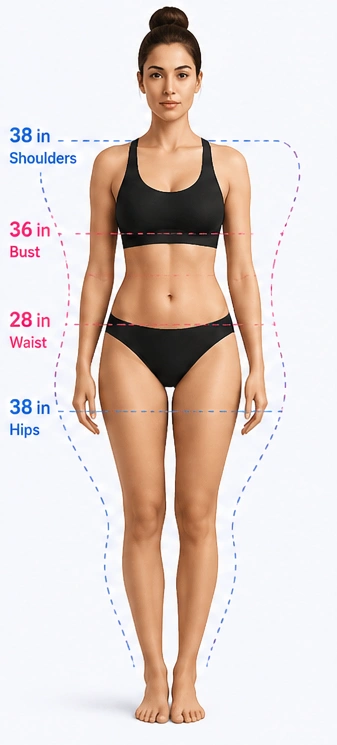
Visualize Your Body Shape
Choose female or male, select inches or centimeters, then enter your measurements to generate a visual body-shape estimate and proportional ratios.
Hourglass Body Shape
What Is a Body Shape Visualizer?
A Body Shape Visualizer is an interactive tool that helps you understand how your shoulders, bust or chest, waist and hips relate to one another. Enter your measurements and the tool compares these proportions to common body-shape patterns.
Unlike simply looking in a mirror, a body visualizer uses measurable proportions. This can make it easier to understand whether your figure is closer to an hourglass, pear, apple, rectangle, inverted triangle or one of the common male body types.
The visual result is an estimate rather than an exact digital copy of your body. Human figures vary widely, and many people naturally share characteristics of more than one shape.
How Does the Body Shape Tool Work?
The calculator compares several body measurements rather than relying on weight, height or clothing size alone.
1. Choose Female or Male
Female mode uses bust measurements while male mode uses chest measurements.
2. Choose a Unit
Enter all measurements in inches or all in centimeters for a consistent comparison.
3. Add Measurements
Enter shoulders, bust or chest, waist and hips into the fields above.
4. View Your Shape
The visual model changes to show the closest proportional body-shape pattern.
Visualizing Common Female Body Shapes
Female body shapes are commonly described by the relationship between the bust, waist, hips and shoulders. The categories below are useful shorthand for describing proportions rather than strict rules.
Hourglass
Bust and hips are relatively balanced while the waist is more defined.
Pear
Hips are proportionally wider than the upper body.
Apple
The midsection is relatively fuller compared with other areas.
Rectangle
Bust, waist and hips form a straighter overall silhouette.
Inverted Triangle
Shoulders or bust are proportionally broader than the hips.
Women who want a more focused calculation can use our Female Body Type Calculator to compare bust, waist and hip proportions in greater detail.
Visualizing Common Male Body Types
Male body shape is usually evaluated by comparing shoulder and chest width with the waist and hips. These proportions can produce several recognizable torso patterns.
Upper-Body Dominant Shapes
An inverted triangle typically has noticeably broader shoulders and a narrower waist. A trapezoid also tapers toward the waist but usually has a more moderate difference between the upper and lower torso.
Straight or Fuller Shapes
Rectangle proportions show less difference between shoulders, waist and hips. Triangle proportions are wider toward the lower torso, while an oval shape generally has a fuller midsection.
For a dedicated male calculation, visit the Male Body Type Calculator .
Measurements Needed for Body Visualization
A measurement-based visualizer works best when each body measurement is taken consistently and the tape is positioned correctly.
Provides an upper-body reference for comparison with the hips.
Bust is used for female calculations and chest for male calculations.
Shows how much the torso narrows or remains fuller through the middle.
Represents the lower-body circumference used for proportional comparison.
If you are unsure how to take these measurements, see our Body Measurements Guide . Women can also follow the step-by-step guide on How to Measure Bust, Waist and Hips .
Why Body Proportions Matter
Body type is based more on the relationship between measurements than on their absolute numbers. Two people can therefore have very different measurements while still showing similar proportional patterns.
The Body Shape Visualizer compares several ratios to estimate how the upper body, waist and lower body relate to one another.
Compares the middle torso with the hips.
Compares upper-torso circumference with hips.
Compares upper-body width with lower-body width.
Body Shape Comparison Chart
This table summarizes the general proportional characteristics used to describe common body shapes.
| Body Shape | Upper Body | Waist | Hips | General Pattern |
|---|---|---|---|---|
| Hourglass | Balanced with hips | More defined | Balanced with bust | Curved with narrower middle |
| Pear | Relatively narrower | Variable | Wider | Lower-body dominant |
| Apple | Variable | Fuller | Variable | More volume through middle |
| Rectangle | Similar proportion | Less defined | Similar proportion | Straighter silhouette |
| Inverted Triangle | Broader | Narrower | Relatively narrower | Upper-body dominant |
| Trapezoid | Moderately broad | Defined | Moderate | Gradual upper-body taper |
| Triangle | Narrower | Variable | Relatively wider | Wider lower torso |
| Oval | Variable | Fuller | Variable | Rounded midsection |
Body Visualizer vs Body Shape Calculator
Both tools use measurements, but they present the information differently.
👁 Body Visualizer
A body visualizer emphasizes the visual relationship between different measurements. The silhouette helps users see how broader shoulders, a narrower waist or wider hips can influence the overall figure.
🧮 Body Shape Calculator
A calculator focuses more directly on ratios and the resulting category. If you mainly want to determine your body type, use our main Body Type Calculator .
Body Visualizer, Visualiser and Body Simulator
People use several terms when searching for tools that display body proportions, including body visualizer, female body visualizer, body shape visualiser, body visualization, body simulator and body model. Although the wording differs, the common goal is to understand how different measurements affect the appearance of a body shape.
This tool uses a simplified silhouette rather than attempting to generate a photorealistic body model. It is designed to make proportional differences easier to understand while keeping the calculation simple and private.
If your main question is “what body shape am I?”, measurement ratios generally provide a more consistent starting point than trying to classify your figure from a single photograph.
How Accurate Is a Body Shape Visualizer?
The result depends on the measurements entered and the proportional rules used by the tool. Incorrect tape placement, posture or inconsistent measurement units can change the result.
Body shapes also exist on a continuum. For example, someone may have mostly pear-shaped proportions while sharing some hourglass characteristics. For that reason, the result should be viewed as an estimated body-shape category rather than a rigid classification.
The tool is intended for general body-proportion visualization. It is not designed to diagnose health conditions, assess body composition or replace professional medical evaluation.
Measurement reference: Anthropometry refers to systematic measurement of human body dimensions. You can read the NCBI overview of anthropometric measurement . The World Health Organization also provides guidance concerning waist and hip circumference measurement.
Can I Use Inches or Centimeters?
Yes. You can enter body measurements in either inches or centimeters. The important point is to use the same unit for shoulders, bust or chest, waist and hips during one calculation.
One inch is equal to exactly 2.54 centimeters. Because proportional calculations compare one measurement with another, changing all values to the same alternative unit does not change their underlying ratios.
For U.S. customary and metric measurement conversions, see the NIST unit conversion resource .
Body Type Calculators & Measurement Guides
Explore these related tools and guides for more detailed body measurements and calculations.
Body Shape Visualizer FAQs
What is a Body Shape Visualizer?
It is a measurement-based tool that compares body proportions and displays a simplified visual estimate of the closest body-shape pattern.
What measurements do I need?
You need shoulder, bust or chest, waist and hip measurements. Keep all values in the same measurement unit.
Can women use this body visualizer?
Yes. Female mode compares shoulders, bust, waist and hips to estimate common female body-shape patterns.
Can men use the visualizer?
Yes. Male mode compares shoulders, chest, waist and hips to estimate common male torso proportions.
Is this the same as a body simulator?
It provides simplified body visualization based on measurements. It does not generate a photorealistic or anatomically exact model of the user.
Can I enter measurements in centimeters?
Yes. Both inches and centimeters can be used as long as every measurement in the same calculation uses the same unit.
Is the result medically accurate?
No. The result is a general estimate of body proportions and is not a medical assessment, diagnosis or body-composition test.
Visualize Your Body Proportions
Enter your shoulder, bust or chest, waist and hip measurements in the tool above to see the body-shape pattern that most closely matches your proportions.
👁 Use the Body Shape Visualizer ↑